
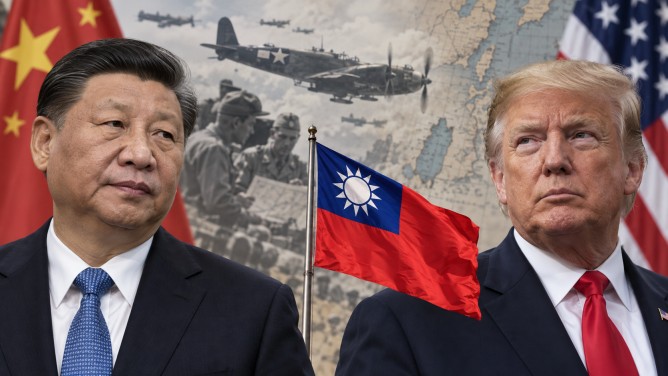
Taiwan is grappling with a renewed debate over its wartime history following recent remarks by US President Donald Trump and Chinese President Xi Jinping that highlighted the cooperation between the United States and China during World War II. During their summit, Trump characterized China as a US ally in the war, praising the Flying Tigers, an American military unit that provided support to China against Japanese air attacks. Xi also emphasized the joint efforts of the two nations against Japan during the conflict.
These references have stirred concerns in Taiwan, where the government insists that the China which allied with the United States in World War II was the Republic of China (ROC). The ROC governed China during that period and relocated to Taiwan in 1949 following its defeat in the Chinese civil war. Taiwanese officials have accused Beijing of attempting to bolster its historical narrative by invoking this period of cooperation.
Opposition figures in Taiwan have criticized the current government for distancing itself from the ROC’s pre-1949 history, reflecting a broader dispute between Beijing and Taipei over the historical legacy of wartime China. Analysts suggest that the renewed focus on World War II cooperation could further complicate Taiwan’s efforts to establish its historical and political identity while maintaining strong relations with the United States.
This ongoing historical dispute underscores the challenges Taiwan faces in navigating its complex relationship with both China and the United States, as it seeks to assert its identity on the global stage. The emphasis on wartime cooperation has brought to the forefront the delicate balance Taiwan must maintain in its diplomatic and historical narratives.