
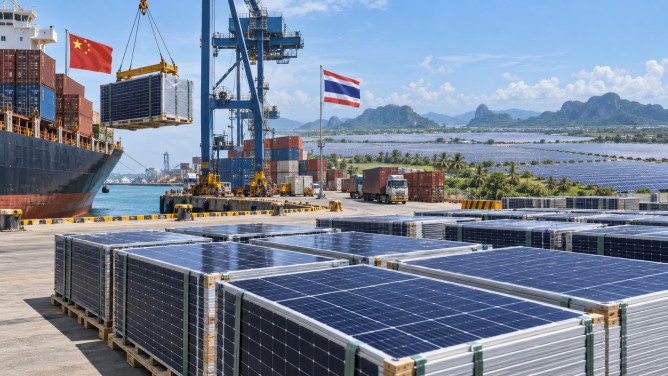
As Thailand intensifies its focus on renewable energy, the country is witnessing a significant surge in solar panel imports. Data from Thailand’s Ministry of Commerce and Customs Department reveals that solar panel imports reached an impressive US$426.7 million in the first seven months of 2026, marking an 88.7% increase compared to the previous year. This surge is largely fueled by imports from China, which alone accounted for 99.3% of the total import value.
China’s contribution to Thailand’s solar panel imports surged to US$423.9 million, registering a remarkable 107.1% rise from the same period last year. Meanwhile, other suppliers like Singapore and Hong Kong made only minor contributions, each representing approximately 0.3% of the total value. This trend underscores China’s dominant role in Thailand’s solar energy supply chain.
The spike in imports aligns with Thailand’s strategic initiative to launch a household solar installation program. This program aims to offer subsidies of about THB50,000 per household, with an initial target of equipping one million homes with solar panels. There is potential for this target to expand to 1.5 million households, emphasizing the government’s commitment to promoting sustainable energy solutions.
To complement the growing demand for solar energy, Thai officials are also exploring measures to bolster domestic solar manufacturing. Efforts include collaborations with the Ministry of Labour to enhance workforce skills in solar panel assembly, installation, and maintenance. Additionally, discussions with the Board of Investment are underway to consider reducing duties on production inputs that are not readily available within the country.
Ultimately, Thailand’s solar energy initiatives are poised to not only reduce household electricity costs but also pave the way for a robust domestic clean-energy supply chain. By encouraging both rooftop and ground-mounted solar installations, the government is taking significant steps toward a more sustainable and energy-independent future.