
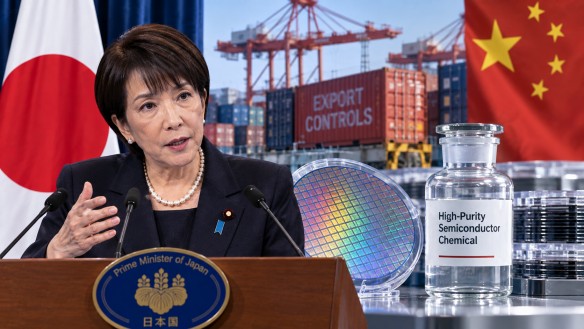
The Japanese government has lodged a protest against China’s newly imposed restrictions on the export of dichlorosilane (DCS), a chemical essential in the production of semiconductors. These new constraints, which demand that Chinese importers of Japanese DCS pay cash deposits as high as 99.2%, have sparked concern in Japan. Authorities in Tokyo are currently evaluating how these measures might impact Japanese firms, particularly major exporters like Shin-Etsu Chemical and Denal Silane.
China has defended its actions by labeling them as provisional, citing results from an anti-dumping investigation indicating that Japanese DCS exports have negatively affected its domestic industry. The restrictions are set to remain in place until the investigation reaches its conclusion and a final determination is made. Meanwhile, Japan has called on China to ensure that these regulatory measures do not unfairly prejudice Japanese enterprises, warning that it might take necessary countermeasures if required.
This trade friction between the two countries occurs against a backdrop of deteriorating diplomatic relations, particularly over Japan’s stance on Taiwan. The tension has been compounded by other trade and export limitations that China has recently imposed on Japanese companies, especially concerning dual-use products that could have military applications.
Dichlorosilane plays a critical role in semiconductor manufacturing, where it is used to create ultra-thin silicon layers on computer chips. As Japan stands as a leading global supplier of ultrapure DCS, the restrictions imposed by China could have significant repercussions for the semiconductor supply chain, an industry already grappling with various challenges.