
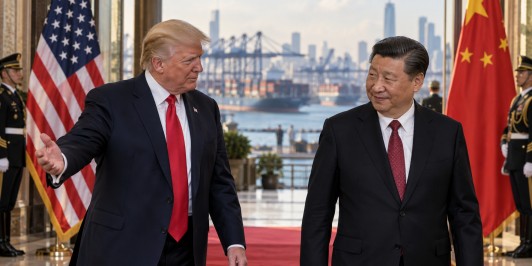
As the United States and China navigate ongoing tensions over trade and technological dominance, Chinese President Xi Jinping has embarked on a state visit to Washington, D.C. The visit, highlighted by a ceremonious welcome at Joint Base Andrews, emphasizes the importance both nations place on managing their strategic relationship. U.S. President Donald Trump, alongside First Lady Melania Trump, personally greeted Xi and his wife, Peng Liyuan, underscoring the significance of the diplomatic engagement.
The high-profile reception, complete with military honors, national flags, and a flyover by two U.S. B-1 bombers, sets the stage for discussions aimed at easing trade tensions. In a significant development, U.S. Treasury Secretary Scott Bessent announced the extension of the Busan agreement, a temporary trade truce between the two economic giants. This extension prolongs the agreement until January 10, allowing for continued dialogue on contentious trade issues.
Trade negotiations are a central focus of Xi’s two-day visit, as both countries attempt to reconcile economic policies and address mutual concerns. Beyond trade, discussions are expected to cover a wide range of topics, including artificial intelligence and technology, areas where both nations are fiercely competitive. These talks are crucial as the U.S. and China vie for supremacy in advanced technologies, with each country eager to bolster its position in the sector.
During his visit, President Xi will engage in a series of official meetings, including discussions with President Trump at the White House. These engagements aim to explore avenues for reducing economic and strategic tensions while maintaining open channels for communication. The state visit underscores the complex interplay of competition and cooperation that defines U.S.-China relations in the current geopolitical landscape.
The ongoing competition over technology and innovation highlights the broader implications of Xi’s visit. As the U.S. and China strive for dominance in artificial intelligence and other cutting-edge fields, the outcomes of these diplomatic efforts could have lasting impacts on global technological leadership. The state visit thus serves as a pivotal moment for both countries to address their differences and seek collaborative solutions in an increasingly interconnected world.