
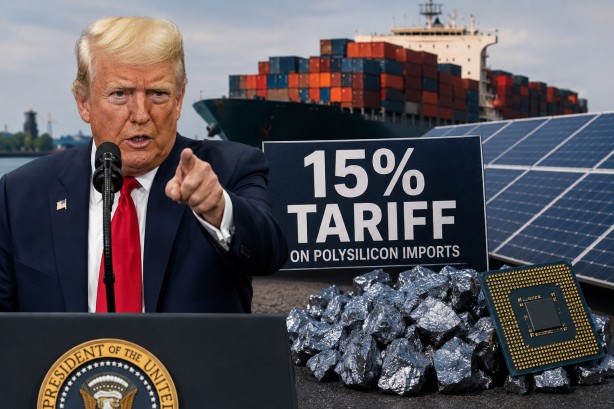
In a move to bolster domestic production and lessen dependency on China, U.S. President Donald Trump has announced a new 15% tariff on imported goods made with polysilicon. This material is essential in the manufacturing of semiconductors and solar panels, and the tariff is set to commence on December 4. This action is part of a broader strategy to enhance the United States’ self-reliance in critical technological sectors.
Polysilicon, an exceedingly pure form of silicon, plays a vital role in producing semiconductors that drive artificial intelligence and data centers, as well as in the creation of solar cells and panels. Currently, China holds the status as the leading producer of this crucial material. The newly introduced tariffs will also enforce minimum import prices, setting them at $21 per kilogram for polysilicon, $100 per kilogram for polysilicon ingots and wafers, $0.22 per watt for solar cells, and $0.38 per watt for solar modules and panels.
The U.S. government has emphasized that these measures are designed to support the sustainability of domestic polysilicon production while fortifying key supply chains integral to the nation’s economic and national security. This policy shift aims to foster a competitive environment for U.S.-based manufacturers and reduce the nation’s reliance on foreign imports.
China has expressed disapproval of the U.S. decision, accusing the American government of misapplying national security justifications to limit Chinese business operations and cautioning that such protectionist strategies could potentially disrupt trade relations between the two nations. Despite these criticisms, U.S. officials remain focused on encouraging investment within the domestic polysilicon industry by introducing incentives for companies that expand their operations in the sector.
The United States currently houses two major polysilicon facilities, operated by Hemlock Semiconductor in Michigan and Wacker Chemie in Tennessee. This tariff measure coincides with China’s continued robust growth in exports, particularly in areas like electronics, artificial intelligence-related products, and other high-value manufacturing categories. As global trade dynamics evolve, the U.S. administration is keen on cultivating a more independent supply chain infrastructure to safeguard its economic interests.